
Total Dissolved Solids (TDS)
What are Total Dissolved Solids?
Total Dissolved Solids (TDS) are the amount of organic and inorganic materials such as metals, minerals, salts, and ions that are dissolved in water.
HOW DO TOTAL DISSOLVED SOLIDS (TDS) GET INTO YOUR WATER?
Total Dissolved Solids (TDS) is a measurement of the dissolved minerals, salts, metals, and organic matter that are naturally present in water. These dissolved substances can come from rocks and soil as water moves through the environment, but they can also enter water supplies through agriculture, road salt, industrial activity, and aging infrastructure. Because every water source is different, TDS levels can vary significantly depending on where you live and whether your home uses municipal water or a private well.
On its own, a high TDS reading does not necessarily mean your water is unsafe to drink. In fact, many dissolved minerals, such as calcium and magnesium, occur naturally and are common in drinking water. However, elevated TDS levels can change the taste, odor, or appearance of water, often creating a salty, bitter, or metallic taste. High TDS may also indicate that additional testing is worthwhile, as it can sometimes be associated with contaminants that require treatment. From a household perspective, excess dissolved minerals can contribute to scale buildup inside plumbing, water heaters, dishwashers, and other water-using appliances, reducing efficiency and increasing maintenance over time. If testing reveals elevated TDS or other water quality concerns, treatment options such as reverse osmosis systems can significantly reduce dissolved solids in drinking water, while a water softener can help manage hardness minerals that contribute to scaling throughout the home.
Here is a list of common total dissolved solids that may be present in your water -
|
Chloride |
Chlorine |
Potassium |
Zinc |
|
Aluminum |
Herbicides |
Copper |
Arsenic |
|
Iron |
Lead |
Sodium |
Fluoride |
|
Bicarbonates |
Pesticides |
Magnesium |
Sulfates |
See If Your Water Contains TDS
Contact A Kinetico Water Expert Today
Fill out your information below and we’ll have one of our authorized, independent Kinetico dealers contact you to schedule your free in-home water test.
SIGNS OF HIGH TDS
Total dissolved solids are present in virtually all water supplies, but the levels can vary dramatically. You may not realize you have high levels of TDS, but you can look for a few signs such as issues with your home’s plumbing system or water-using appliances, scale on fixtures, poor water taste, cloudy water, or problems with your skin. Depending on what makes up the TDS in your water, you may not notice anything is amiss or you may have grown accustomed to having water with high amounts of TDS.
Metallic taste - Water that tastes like metal can indicate the presence of iron, copper, manganese, zinc or other metals. Though not harmful in trace amounts, large quantities of both zinc and copper can be harmful to humans.
Scale in water pipes - Just as scale build-up forms on fixtures, it also forms in water pipes. Although you can’t see it, mineral deposits build up inside water pipes and reduce water pressure. In extreme situations, this can lead to pipe replacements and other challenges in your home.
Cloudy Water - If your water is cloudy, or contains a brownish tint, it typically means that you have dissolved or suspended solids in it. Also referred to as turbidity, it is often difficult to determine what the exact contaminant is. Without testing and filtration, these solids can cause build-up in your pipes and appliances, leading to costly replacements.
SCHEDULE A WATER TEST TO SEE WHAT'S IN YOUR WATER

HOW TO REDUCE TOTAL DISSOLVED SOLIDS IN WATER?
Depending on your TDS levels and what other issues you may have with your water, there are a number of water treatment systems available, both whole home and point-of use, to improve your water. Reverse osmosis is one of the most popular methods to significantly reduce TDS from your drinking water.
Reverse osmosis, or RO, is a water treatment process in which water passes through a semi-permeable membrane. Holes, or pores, in the RO membrane, are just big enough for the passage of a water molecule. Even small particles such as tobacco smoke or paint pigments are too big to flow through an RO membrane. The water that makes it through a reserves osmosis system is high quality, virtually contaminant-free, and clean.
Kinetico offers reverse osmosis systems that are third-party certified to reduce more contaminants than other comparable systems. We also provide customizable RO systems that allow you to include filter cartridges for specific contaminant removal or to add minerals for taste.
Schedule A Water Test Today To See Which Softener Is Best For You
THE KINETICO K5 DRINKING WATER STATION
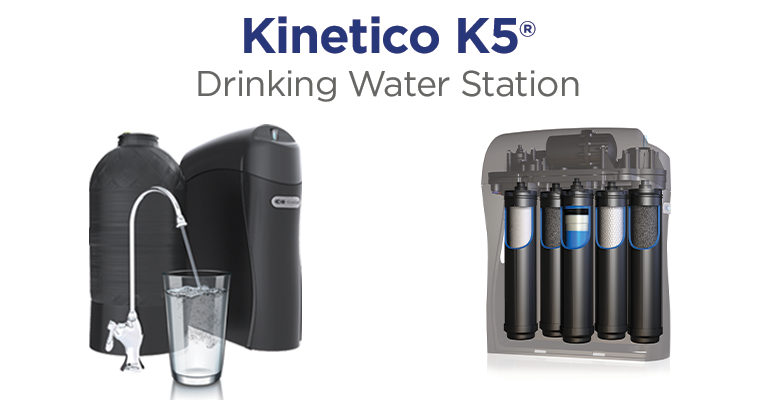
The Kinetico K5 Drinking Water Station is a seven-stage reverse osmosis system featuring QuickFlo® technology to provide a consistent flow of high-quality water whenever you need it. In fact, Kinetico’s K5 produces more water faster than any other reverse osmosis system in its class. The K5 is also one of the few reverse osmosis systems that is third-party certified for PFOS/PFOA removal.